
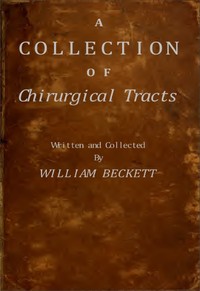
A Collection of Chirurgical Tracts by William Beckett
Let's be clear from the start: this isn't a storybook. A Collection of Chirurgical Tracts is exactly what it sounds like—a compilation of professional writings by William Beckett, a London surgeon practicing in the early 1700s. Think of it as his blog, if blogs were handwritten, concerned with tumors, and published centuries ago. The 'plot' is the daily drama of his practice. Each tract tackles a specific medical issue: how to treat a gunshot wound, the best method for amputating a limb, observations on strange tumors, or advice for setting broken bones.
The Story
There's no traditional narrative arc. Instead, you follow Beckett's clinical mind as he confronts the medical puzzles of his age. He describes cases in stark detail, from the initial symptoms to the often brutal procedures, and shares his thoughts on what worked and what didn't. You see his frustration with the limits of his knowledge and his determination to improve. The 'characters' are his patients—sailors with scurvy, women with breast cancers, men mangled by industrial accidents—and the constant, looming antagonist is infection, which he didn't yet understand. The story is the slow, hard-won accumulation of practical knowledge, written in blood, pus, and ink.
Why You Should Read It
I picked this up out of historical curiosity and couldn't put it down. It's gripping in the most unsettling way. Beckett's voice is direct, practical, and occasionally surprisingly compassionate. Reading his precise descriptions of surgeries performed on conscious patients is a visceral reminder of how far we've come. But more than that, it shows the roots of the scientific method in medicine. Beckett is observing, testing, and arguing with other surgeons' methods. You witness the birth of modern surgical thinking, where careful observation starts to edge out pure tradition. It makes you incredibly grateful for modern medicine while fostering a deep respect for these early practitioners who worked in near-total darkness.
Final Verdict
This book is perfect for history buffs, especially those interested in medicine, science, or everyday life in the 18th century. It's also great for anyone who enjoys primary sources—getting history straight from the source, without a filter. If you're squeamish, maybe give it a pass; the descriptions are graphic. But if you have a strong stomach and a curious mind, A Collection of Chirurgical Tracts is a uniquely fascinating and sobering look at the brutal reality of healthcare before the modern era. It's not an easy read, but it's an unforgettable one.
This publication is available for unrestricted use. You can copy, modify, and distribute it freely.
Ethan Davis
1 year agoI started reading out of curiosity and the atmosphere created is totally immersive. Definitely a 5-star read.
Mark Hernandez
5 months agoAfter hearing about this author multiple times, the arguments are well-supported by credible references. Absolutely essential reading.
Patricia Smith
1 year agoHelped me clear up some confusion on the topic.
Lucas King
1 year agoText is crisp, making it easy to focus.







Donald Thomas
2 months agoIt took me a while to process the complex ideas here, but the case studies and practical examples provided add immense value. This is a solid reference for both beginners and experts.