
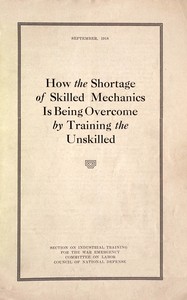
How the shortage of skilled mechanics is being overcome by training the…
This isn't a novel with characters in the traditional sense. The 'characters' are the U.S. government, American industry, and thousands of ordinary citizens. The 'plot' is the desperate scramble to win World War I on the home front.
The Story
The book lays out a clear, urgent problem: the nation needs a massive, sudden increase in skilled mechanics to produce war equipment. Traditional multi-year apprenticeships are a luxury they don't have. So, the Committee on Labor details its emergency plan. They describe setting up intensive, short-term training programs in factories, schools, and even on college campuses. They talk about standardizing skills so a worker trained in Detroit can be useful in Philadelphia. It's a step-by-step account of trying to build a technical workforce from scratch, under immense pressure, with the outcome of the war literally depending on its success.
Why You Should Read It
What grabbed me was the sheer scale of the problem and the blunt, no-nonsense approach to solving it. There's no fluff here. It's all action: 'We need this, so we did that.' You feel the urgency on every page. It's a powerful reminder of how a society can mobilize when it has to. It also makes you think about the value of skilled trades in a way we often forget today. These weren't just jobs; they were vital national defenses. Reading it, I kept drawing parallels to modern challenges—like suddenly needing to ramp up production of medical equipment or computer chips. The core lesson is the same: how do you quickly train people for critical work?
Final Verdict
This is a niche read, but a rewarding one. It's perfect for history buffs who love the gritty, logistical details behind big events, not just the battles. If you're interested in how things get made, in workforce development, or in stories of American ingenuity under pressure, you'll find this short document surprisingly compelling. It's not a beach read, but for the right reader, it's a fascinating dive into a moment when training a mechanic was an act of patriotism.
This work has been identified as being free of known copyright restrictions. You can copy, modify, and distribute it freely.
Lucas Robinson
1 year agoI stumbled upon this title and the content flows smoothly from one chapter to the next. Worth every second.
Lisa Wright
1 year agoSurprisingly enough, it provides a comprehensive overview perfect for everyone. Worth every second.
Emma Clark
1 year agoHigh quality edition, very readable.
William Lewis
1 year agoHonestly, the atmosphere created is totally immersive. I would gladly recommend this title.







Joseph Allen
1 year agoVery interesting perspective.