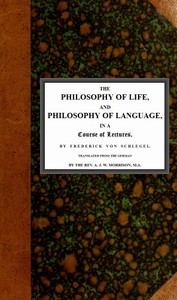
The philosophy of life, and philosophy of language, in a course of lectures
Let's be clear from the start: this book is a collection of lectures, not a novel. There's no plot in the traditional sense. Instead, imagine you've signed up for the most ambitious university course ever. The professor, Friedrich von Schlegel, a key figure in German Romanticism, walks in and declares he's going to connect two huge subjects over the semester: the meaning of life and the mechanics of language.
The Story
Schlegel builds his case step by step. He starts with language, examining it not just as grammar, but as a living, creative force. He looks at poetry, conversation, and even misunderstanding to show how language actively shapes our world. Then, he pivots to life's big questions—art, love, religion, history—and argues that our answers are always filtered through this linguistic framework. The 'story' is the journey of his argument, how he tries to prove that these two fields aren't separate. They are fundamentally linked. You can't have a true philosophy of life without a deep philosophy of language, and vice versa. The tension comes from watching him try to bridge this enormous gap.
Why You Should Read It
I picked this up expecting dense theory, and yes, it's there. But what surprised me was Schlegel's passion. You can feel his excitement. He isn't writing a dry manual; he's trying to start a revolution in thinking. His idea that language is creative, not just descriptive, feels incredibly modern. When he talks about poetry being a higher form of knowledge, it makes you look at art in a new way. It’s a book that makes you slow down and question your own assumptions about every sentence you speak and every belief you hold. It’s less about giving you answers and more about upgrading the questions you ask.
Final Verdict
This is not for the casual reader looking for a light narrative. It's perfect for students of philosophy, writers, linguists, or anyone fascinated by the roots of Romantic thought. If you enjoy writers like Wittgenstein or modern thinkers who play with language and meaning, you'll find a fascinating precursor here. Approach it like a challenging but rewarding seminar. Don't try to swallow it whole; take it a lecture at a time, argue with it in the margins, and let it stretch your mind. It’s a historical artifact, but its core questions are still buzzing loudly today.
Linda Wright
1 year agoAfter hearing about this author multiple times, it creates a vivid world that you simply do not want to leave. Truly inspiring.
Emma Clark
2 months agoIf you enjoy this genre, it manages to explain difficult concepts in plain English. Worth every second.
Donna Hernandez
4 months agoIf you enjoy this genre, the author's voice is distinct and makes complex topics easy to digest. Highly recommended.
Richard White
1 year agoSimply put, the character development leaves a lasting impact. Truly inspiring.
Lisa Smith
2 years agoVery interesting perspective.