About 553 minutes
Journal of a Voyage to Brazil And Residence There During Part of the Years 1821, 1822, 1823 — Story, Setting & Ideas
Geography
127,001 recorded words. 6 minutes difference from this book's estimate.
View Gutenberg source #21201
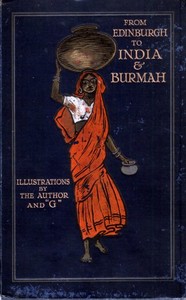
For From Edinburgh to India & Burmah — Reading Companion, the stored edition analysis reports 125,662 words, 9 hr 7 min estimated reading time, and 17 detected text sections.
The text analysis averages about 28.3 words per sentence, while the detected sections provide another way to judge how the source is divided.
Project Gutenberg metadata also associates the work with “India -- Description and travel,” connecting these edition facts with the source record’s subject description.
Explore this collection
These alternatives are selected using recorded categories and estimated reading time.
About 553 minutes
Geography
127,001 recorded words. 6 minutes difference from this book's estimate.
View Gutenberg source #21201About 557 minutes
Geography
128,006 recorded words. 10 minutes difference from this book's estimate.
View Gutenberg source #35676About 531 minutes
Geography
121,911 recorded words. 16 minutes difference from this book's estimate.
View Gutenberg source #35224Search stored excerpts and compare books → Choose by your preferences →
Choices use stored catalog measurements. Estimates vary with reading speed. A shared category is a catalog label, not a claim that two books have the same argument or literary quality.
Search reads excerpt text stored with this catalog and links to its associated Gutenberg record. The connection is stored in the site database; this tool does not recheck that every excerpt is word-for-word identical to that external record. Excerpt search does not cover every chapter and does not verify historical publication dates.
Catalog snapshot checked: 2026-09-26. Coverage: 97 public books, 97 available source excerpts.
Calculated from edition completeness, EPUB availability, text structure and catalogue metadata. Not a user rating.
Total of 100 points, scaled to a 2.5-5.0 range. Editions with an empty description or a missing EPUB file are not scored.
Public-domain source text
The source text is kept in the dedicated reader, separate from this catalogue record and its commentary.
From the first chapter, Burn Murdoch announces his method as 'digressions,' and the book keeps that promise. The journey from Edinburgh to India and Burma is less a linear itinerary than a series of framed scenes—a street in Edinburgh, a deck on a P.&O. steamer, a moonlit fort in Madras—each rendered with a painter's eye for light and a diarist's ear for conversation. The author, also the illustrator, frequently shifts between the grand and the trivial: royal receptions and a stolen fish, vice-regal processions and a children's party in a Eurasian quarter. This editorial note attends to the work's structure, its recurring images, and the way movement between scenes creates a distinctive travel narrative.
The table of contents signals the book's unconventional architecture. Chapter headings read like a list of afterthoughts: 'Introducing these Digressions,' 'Chronicles small beer,' 'Is still about the Red Sea.' Burn Murdoch does not pretend to offer a systematic survey of India and Burma. Instead, he strings together episodes linked by association rather than chronology. A chapter on the Red Sea includes digressions on 'rose-red Italian wine, & Ulysses, and Callum Bhouie, and Uisquebaugh.' The effect is conversational, as if the reader is seated beside him on deck. This structure allows him to juxtapose a formal vice-regal reception with a dream sequence in which a prince corrects the Royal Academies—a satirical aside that would feel out of place in a conventional travelogue. The digressions are not flaws but the book's organizing principle, mirroring the meandering pace of the voyage itself.
Burn Murdoch was a painter, and his prose repeatedly returns to the quality of light and colour. In Madras, he notes the Marina 'all changed to evening colours,' and describes a moonlit fort where 'a pale crescent moon lit up part of a building here and there.' The Red Sea is 'fizzling hot blue,' and Port Said appears with its inhabitants in a single, vivid sketch. These observations are not mere decoration; they structure the narrative by marking transitions between scenes. The shift from the 'warm evening twilight' of the Marina to the 'darkness' of the old Fort is both a literal movement and a temporal one, from modern India to 'the old India of the Company days.' Colour also signals social observation: the 'pretty children in white' at a Eurasian party, the 'immaculately dressed youth' with a straw hat. The painter's eye never rests, and it gives the book a consistent sensory texture.
The narrative repeatedly crosses boundaries between formal and informal spaces. One moment the author attends a royal reception with 'gun-firing, and the Bands playing God save the King'; the next, he watches fishermen have their catch stolen by policemen, and comments, 'I hope someone in authority will read this and have them tied heel and neck.' This oscillation is deliberate. At the Fort in Madras, he leaves a dinner party to speak with soldiers on the parapet, reflecting that 'private soldiers, or fishermen and sailors can tell you stories better than any other class of men.' The book values these encounters—with a 'beautiful French lady' on board, with a serang, with 'two soldiers lounging'—as much as the official pageantry. The movement between these worlds is often physical: a drawbridge, a subterranean arch, a long drive in the dark. Each transition signals a shift in register, from the public to the intimate, the ceremonial to the candid.
Burn Murdoch's persona is that of a wry, observant Scot, quick to mock pretension ('Respectability and Art') and to side with the underdog. He admits to using 'the artist's modest manner' to draw out stories from whaling men. Yet the excerpts also reveal gaps: we do not learn what the soldiers told him, because 'impending dinner and no white waistcoat' cut the conversation short. The book is full of such unfinished threads—a fire alarm, a dummy dinner, a dream of a prince—that hint at more than they deliver. Readers should not expect a comprehensive account of India and Burma; the title's '&' is as digressive as the chapters. The value lies in the particularity of each scene, the honesty about what is observed and what is missed. The author's voice is consistent, but the book remains a collection of fragments, not a finished portrait.
Burn Murdoch's travelogue rewards readers who accept its digressive nature. The book is best approached not as a guide to India and Burma but as a series of sketches—verbal and visual—by a painter who trusts his eye more than any itinerary. Pay attention to the transitions: the moment a drawbridge is crossed, the shift from daylight to moonlight, the move from a royal procession to a quiet conversation. These are where the book's real interest lies. The author's prejudices are evident, but so is his curiosity about people on the margins of official life. Read for the scenes, not the summary.
Burn Murdoch watches the sunlight change over Indian crowds, yet his quietest moments—the lingering look at a stranger’s face—feel like the hushed, measured recall of place I find in The Dukeries — Themes and Context. Both books keep a diary of belonging, not to maps, but to the soft ache of passing through.
Save your reaction, strongest insight, and memorable passage.









