About 398 minutes
Account of a voyage of discovery to the west coast of Corea, and the great Loo-Choo Island — Story, Setting & Ideas
Geography
91,327 recorded words. 11 minutes difference from this book's estimate.
View Gutenberg source #29051
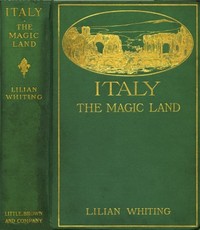
Italy, the Magic Land — Context and Discussion can be approached with a clearer sense of reading commitment from its source measurements: 93,894 words, 6 hr 49 min estimated reading time, and 15 detected text sections.
The text analysis averages about 23.3 words per sentence, while the detected sections provide another way to judge how the source is divided.
Project Gutenberg metadata also associates the work with “Italy -- Description and travel,” connecting these edition facts with the source record’s subject description.
Explore this collection
These alternatives are selected using recorded categories and estimated reading time.
About 398 minutes
Geography
91,327 recorded words. 11 minutes difference from this book's estimate.
View Gutenberg source #29051About 393 minutes
Geography
90,183 recorded words. 16 minutes difference from this book's estimate.
View Gutenberg source #18544About 381 minutes
Geography
87,500 recorded words. 28 minutes difference from this book's estimate.
View Gutenberg source #23284Search stored excerpts and compare books → Choose by your preferences →
Choices use stored catalog measurements. Estimates vary with reading speed. A shared category is a catalog label, not a claim that two books have the same argument or literary quality.
Search reads excerpt text stored with this catalog and links to its associated Gutenberg record. The connection is stored in the site database; this tool does not recheck that every excerpt is word-for-word identical to that external record. Excerpt search does not cover every chapter and does not verify historical publication dates.
Catalog snapshot checked: 2026-09-26. Coverage: 97 public books, 97 available source excerpts.
Calculated from edition completeness, EPUB availability, text structure and catalogue metadata. Not a user rating.
Total of 100 points, scaled to a 2.5-5.0 range. Editions with an empty description or a missing EPUB file are not scored.
Public-domain source text
The source text is kept in the dedicated reader, separate from this catalogue record and its commentary.
Lilian Whiting opens Italy, the Magic Land not with a practical itinerary but with a prefatory note explaining why Florence receives only a passing allusion: she had already devoted a previous volume, The Florence of Landor, to that city. This decision signals a book built on selective, impressionistic fragments rather than comprehensive coverage. The author presents herself as a returning visitor whose memories have been “refracted through the prism of memory,” a phrase that captures her preference for emotional resonance over systematic description.
Whiting’s prose often leans into the lyrical, as when she evokes “resplendent sunset skies” and “poetic association.” Yet the excerpts also reveal a journalist’s habit of incorporating expert testimony: she quotes Professor Spinazzola on the feasibility of a subterranean Herculaneum museum and Dr. Charles Waldstein on the preservation of bronzes. This blend of personal reverie and reported scholarship gives the text an unusual texture.
Whiting’s vocabulary consistently tilts toward the elevated and the emotive. The title itself calls Italy a “Magic Land,” and the prefatory note speaks of “loves and enthusiasms” and “the precious heritage” of travel. She describes St. Peter’s basilica with “golden light through the far windows of the tribune” merging “into the dusk of twilight in which the vast monumental groups gleam wraith-like.” The word “wraith-like” introduces a ghostly note, hinting at the presence of the dead—a theme reinforced by the book’s dedication to Ella (Mrs. Franklin Simmons), whose “earthly form reposes in the beautiful Roman cemetery.”
This diction of enchantment is counterbalanced by a more factual register when Whiting reports archaeological debates. She writes that Professor Spinazzola “believes that Italy may well become one vast museum of antiquities,” and she reproduces his proposal for an underground Herculaneum “lighted by electric arc lights.” The juxtaposition of “magic” and “electric arc lights” is striking: Whiting does not resolve the tension but lets both modes coexist.
Whiting frequently yields the floor to specialists, embedding their words as direct quotations or reported speech. The longest such passage concerns Herculaneum, where she cites Professor Spinazzola, Dr. de Petra, Professor Lanciani, Commendatore Boni, Professor Dall’Osso, and Dr. Charles Waldstein. These voices share a common argument: that Herculaneum, buried by “lava d’acqua” rather than solid lava, could be excavated to create a “perfectly unique underground museum.”
Whiting does not challenge these experts; she presents their views as authoritative. Yet her own voice remains distinct through framing phrases like “he observed” and “thus writes of this buried city.” The effect is a layered text where the author acts as a curator of opinions. Notably, she includes a dramatic quotation from Pliny the Younger describing the 79 A.D. eruption—“a black and dreadful cloud, bursting with fiery and serpentine vapors”—which shifts the tone from scholarly to sublime.
The book’s structure is deliberately fragmentary. The prefatory note warns that the volume “only aim[s] to present certain fragmentary impressions of various sojourns in Italy.” Whiting does not attempt a chronological travelogue or a systematic survey of Italian art. Instead, she moves from St. Peter’s to the Scala Regia to the Raphael Stanze to the Palatine, each mentioned in a single sentence. The Herculaneum section, by contrast, receives sustained treatment with multiple expert quotations.
This unevenness suggests that Whiting prioritizes moments of intense personal or historical resonance over balanced coverage. She lingers on the work of sculptor Franklin Simmons, whose “great studios in the Via San Nicolo da Tolentino” she describes as “a feature of Italy that haunts the imagination.” The word “haunts” recurs, linking the structure to the book’s elegiac dedication. The reader is invited to accept the text as a collection of memories rather than a definitive guide.
Certain sensory details recur across the excerpts. Light is described with precision: “golden light through the far windows of the tribune,” “resplendent sunset skies,” and the proposed “electric arc lights” for an underground museum. Whiting associates light with beauty and memory, but also with transience, as when daylight fades into twilight.
Ruins and burial sites form another thread. The dedication mentions the “beautiful Roman cemetery” where Keats and Shelley are associated; the Herculaneum section dwells on a city “destroyed” in 63 A.D. and buried under “mighty floods.” Whiting quotes Pliny’s account of darkness and shrieks, then immediately pivots to the hope of excavation. This pattern—loss followed by preservation—structures her approach to Italy itself: a land of “poetic association” and “artistic beauty” that survives the inconveniences of travel.
Readers approaching Italy, the Magic Land should expect a hybrid work: part personal essay, part reported feature, part anthology of quoted authorities. Whiting’s voice is most distinctive when she allows herself the lyrical phrase—the “wraith-like” monuments, the “haunted” imagination—but her willingness to include extended expert testimony gives the book a documentary weight. The text rewards those who read for texture rather than itinerary, and who appreciate a turn-of-the-century American perspective on Italy’s art and archaeology.
That rainy afternoon, Whiting’s poetic drift through Italy settled into me — especially her notion of Herculaneum as a hushed, underground museum. The weight of buried rooms stayed with me. Later, idly, I found myself turning pages of Highways and Byways in Surrey — Reading Notes, where quiet footpaths hold their own gentle secrets, much the same way. Just a different stillness.
Answer a few questions and save a private reflection on this device.









