About 594 minutes
Olla Podrida — Reading Companion
Geography
136,514 recorded words. 17 minutes difference from this book's estimate.
View Gutenberg source #23139
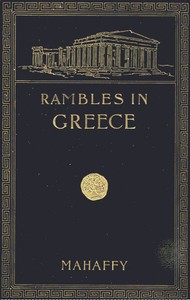
The catalog record for Rambles and Studies in Greece — Background and Themes provides practical reading context through 140,525 words, 10 hr 11 min estimated reading time, and 19 detected text sections.
The text analysis averages about 27.8 words per sentence, while the detected sections provide another way to judge how the source is divided.
Project Gutenberg metadata also associates the work with “Art, Greek,” connecting these edition facts with the source record’s subject description.
Explore this collection
These alternatives are selected using recorded categories and estimated reading time.
About 594 minutes
Geography
136,514 recorded words. 17 minutes difference from this book's estimate.
View Gutenberg source #23139About 632 minutes
Geography
145,236 recorded words. 21 minutes difference from this book's estimate.
View Gutenberg source #16180About 635 minutes
Geography
145,846 recorded words. 24 minutes difference from this book's estimate.
View Gutenberg source #28057Search stored excerpts and compare books → Choose by your preferences →
Choices use stored catalog measurements. Estimates vary with reading speed. A shared category is a catalog label, not a claim that two books have the same argument or literary quality.
Search reads excerpt text stored with this catalog and links to its associated Gutenberg record. The connection is stored in the site database; this tool does not recheck that every excerpt is word-for-word identical to that external record. Excerpt search does not cover every chapter and does not verify historical publication dates.
Catalog snapshot checked: 2026-09-26. Coverage: 97 public books, 97 available source excerpts.
Calculated from edition completeness, EPUB availability, text structure and catalogue metadata. Not a user rating.
Total of 100 points, scaled to a 2.5-5.0 range. Editions with an empty description or a missing EPUB file are not scored.
Public-domain source text
The source text is kept in the dedicated reader, separate from this catalogue record and its commentary.
Mahaffy opens his preface by addressing a common puzzlement: why anyone would visit Greece more than once. He counters the notion that Greece is merely a southern climate with bad food and dirty inns, insisting instead that it offers unparalleled beauty and interest to the intelligent traveller. The book is neither a dry guide nor a romantic eulogy; it is a personal narrative that moves between scenic description, classical association, and candid commentary on contemporary Greek life.
The excerpts show a writer who is as attentive to wildflowers and mountain paths as to the ruins of Olympia. Mahaffy does not hesitate to call the excavations 'exceedingly ugly,' preferring the solitude of an unspoiled landscape. This tension—between the living land and the dead past—runs through the work, making it a distinctive blend of travelogue and cultural criticism.
In the preface, Mahaffy directly confronts the scepticism of those who see Greece as a place of discomfort. He lists its attractions: the 'large effects of natural scenery,' the variety of wildflowers, the unreformed manners of the mountaineers, and the security of life and property—'without troops, or police, or patrols.' This is not a neutral description; it is a polemic against English ignorance. He even ventures into politics, noting 'the unsatisfactory results of a constitution made to order' and a system of free education 'planted in a nation of no political training, but of high intelligence.' The tone is confident, occasionally sardonic, and always engaged with the present as much as the past.
Mahaffy’s account of the journey to Olympia reveals his priorities. He prefers the 'old method of travelling on horseback' to a newly-built carriage road, finding charm in 'unpaved thoroughfares, along meadows, through groves and thickets.' The description of the Alpheus valley in spring is lush and precise: 'the meadows green with sprouting corn and bright with flowers,' the air 'rich with scent of spring.' But when he reaches Olympia itself, the tone shifts. The excavations are 'exceedingly ugly,' the site 'defaced with great mounds of earth, and trodden bare of grass.' The Kladeus has become 'a turbid drain.' Mahaffy’s disappointment is palpable: he found 'hundreds of workmen, and wheel-barrows, and planks, and trenches, instead of solitude and the song of birds.' The passage is a striking example of how the author values the natural and the living over the archaeological reconstruction.
Mahaffy frequently uses classical references to illuminate modern conditions. In the Morea, he observes agriculture 'reaching up steep hillsides, and creeping along precipices, winning from ungrateful nature every inch of niggard soil.' This is contrasted with the rich but fallow plains of Boeotia, which the Greeks attribute to insecurity near the Turkish frontier. The author reports their claim that if the frontier were at Tempe, the northern plains would not lie idle 'through fear of the bandits.' He does not endorse or refute this; he simply records it as part of the contemporary political landscape. Similarly, he imagines the ancient pilgrims to Olympia feeling the same impatience he felt, wondering when they would reach the sacred Altis. This habitual linking of present experience to ancient precedent gives the narrative a layered texture, but Mahaffy never loses sight of the actual ground beneath his feet.
Readers should approach Rambles and Studies in Greece not as a systematic guide but as a personal essay in which observation and opinion are interwoven. Mahaffy’s voice is distinctive: learned, opinionated, and unafraid to call a spade a spade. The book rewards those who enjoy a traveller who is as interested in the wildflowers and the politics of the day as in the ruins of antiquity. The excerpts suggest that the whole work will offer a rich, sometimes cranky, always engaged portrait of Greece at the turn of the twentieth century.
I recall Mahaffy grumbling at the dust of spades, preferring his Greece alive beneath the sun, not buried. There is a gentle patience in that, a love of the living shape over the digging. It reminds me of the quiet companionship found in this other volume, Oxford — Key Ideas to Explore, where stones hold their secrets without being torn open, content to be simply walked past, remembered. A private sort of kinship, that.
Save your reaction, strongest insight, and memorable passage.









