J
Johan Abadie
Guest
- Thread Author
- #1
Most B2B teams pay for firmographic, technographic, and intent data, then let the noisiest of the three decide who gets called. Firmographic data tells you which companies fit your market, technographic data tells you what they run, and intent data tells you who is researching a purchase right now. Intent is also the least reliable of the three on its own: topic-based third-party intent signals had a median precision of 0.51 across 47 deployments in The Starr Conspiracy’s 2024 ABM Operations Audit.
Firmographic data describes what a company is (industry, headcount, revenue, location) and answers “does this account fit?” Technographic data describes what a company runs (CRM, cloud, ERP, security tools, and when each was adopted) and answers “is this account ready for what we sell, and what should we say?” Intent data describes what a company is researching right now and answers “is this account in a buying window?” Use them in that order: firmographics filter the market, technographics rank the accounts that fit, and intent decides when to reach out. Intent on its own is close to a coin flip: The Starr Conspiracy’s 2024 ABM Operations Audit put the median precision of topic-based third-party intent at 0.51 across 47 deployments.
Firmographic, technographic, and intent data answer three different questions about the same account: does it fit, what does it run, and is it looking right now. Confidence drops in the same order the refresh clock speeds up.
The pattern to notice: the faster a data type changes, the lower the confidence in any single reading of it. Firmographics are mostly recorded facts, technographics are inferred from traces, and third-party intent is inferred from behavior attributed to a whole company.
Firmographic data is the set of company-level facts that describe what a business is: its industry, employee count, annual revenue, headquarters location, ownership, and growth stage. Firmographic data is the B2B equivalent of demographics, applied to companies instead of people.
Sales and marketing teams use firmographics to draw the outer edge of a market. “US software companies with 200 to 2,000 employees” is a firmographic filter. So is “manufacturers with more than $50M in revenue in the Midwest.”
Firmographics are the most stable of the three data types, and the least specific. Most teams start with the standard firmographic filters: industry, revenue, headcount, and location. Two companies can match on every firmographic field and still be terrible and perfect prospects, respectively. That gap is what technographic data fills.
Technographic data describes the technology a company uses: its software, hardware, cloud infrastructure, and the dates it adopted (or dropped) each one. Good technographic data also estimates how much the company spends on technology, which hints at budget.
A technographic record looks like “runs Salesforce Sales Cloud since 2021, migrated from on-premise Exchange to Microsoft 365 in 2024, heavy AWS spend.” For a seller, that record answers two questions firmographics can’t. Is this account technically ready for what we sell? And what should the first email say?
Technographics power four common plays (covered in more depth in our guide to technographic data): competitive displacement (target accounts running a competitor), complementary selling (target accounts running a tool you integrate with), readiness filtering (skip accounts missing a prerequisite technology), and renewal timing (reach out as an install anniversary approaches).
Intent data is behavioral evidence that a company is researching a topic, product category, or competitor, collected from content consumption, searches, review-site activity, and visits to your own website. Intent data is the only one of the three types that says anything about timing.
Intent data comes in two forms:
The noise is measurable. Topic-based third-party intent signals had a median precision of 0.51 across 47 deployments in The Starr Conspiracy’s 2024 ABM Operations Audit, rising to 0.63 in mature programs. In plain terms: roughly half the accounts a typical team flags show no CRM-corroborated engagement within 30 days.
The core difference between firmographic and technographic data is that firmographics describe what a company is, while technographics describe what a company runs. Firmographic data defines whether an account belongs in your market; technographic data tells you whether that account is ready for your product and how to position it.
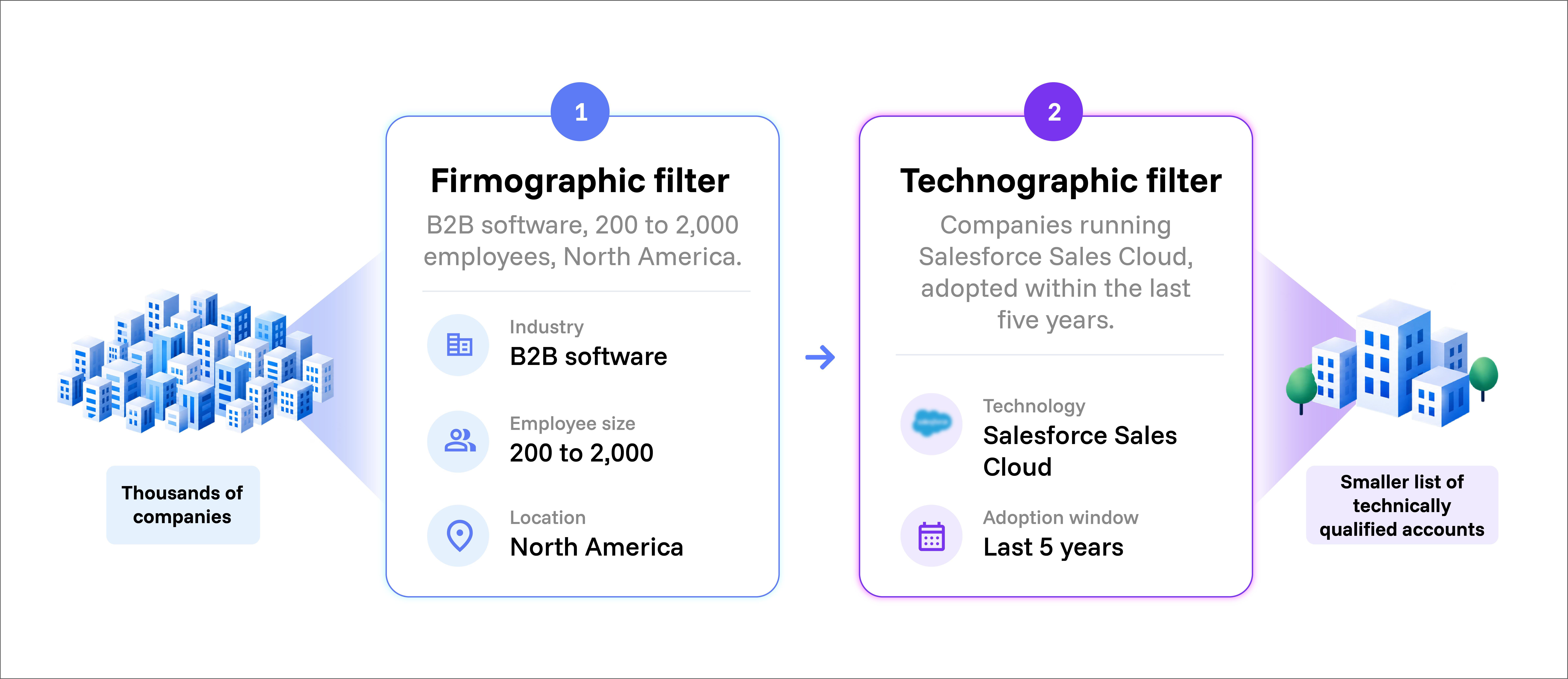
Put the two side by side on a real targeting question. Say you sell a Salesforce-native revenue tool:
The product decides which matters more. If you sell something that plugs into or replaces a specific tool, technographics matter more. A perfect firmographic fit running the wrong stack can’t buy. If you sell something stack-agnostic (payroll, office space, legal services), firmographics carry most of the weight.
Intent data and technographic data answer different questions: technographic data says an account is ready to buy what you sell, and intent data says the account may be shopping now. Technographics describe a state that lasts months; intent describes behavior that fades in days or weeks.
The two are strongest together. An account running a competitor’s tool (technographic) that starts researching your category (intent) is a far better bet than either signal alone. An intent surge on an account with no compatible stack is usually a researcher or a vendor doing competitive homework.
Buyer intent data or technographics? Both, in that order: the technographic fit first and the intent signal second, because readiness without timing is a future opportunity, and timing without readiness is a wasted call.
Firmographic and technographic data come from different places, and the source decides how much you can trust each field. Firmographic data comes mostly from public records; technographic data has to be inferred from the traces a company’s tools leave behind, which makes the collection method the main driver of accuracy.
The reason methods 3 to 5 matter: the average company used 101 apps in 2025, per Okta’s Businesses at Work 2025 report. Most of those apps (the ERP, the HR system, the security stack) never touch a company’s public website. A provider that relies only on website scans sees a thin slice of that stack and calls it complete.
Third-party intent comes from publisher co-ops, ad bidstream data, and review sites, resolved to a company by IP address or cookie. First-party intent comes from your own website analytics, marketing automation, and CRM activity.
Intent data should lead exactly one GTM job, timing outreach, and only on accounts the other two data types already qualified. Firmographic data leads the jobs that define or size a market, and technographic data leads every job that depends on what an account runs.
Treat a hot intent score on an unqualified account as a reason to check your filters, not a reason to call.
Combine firmographic, technographic, and intent data in a fixed order: filter by firmographics, rank by technographics, then time outreach with intent. The order matters because each data type is a gate for the next, and running them out of order lets the noisiest signal override the most reliable ones.
The most common mistake is step 3 jumping the queue. A dashboard full of red-hot intent scores feels like pipeline. But an intent surge on an account you can’t sell to is a reliable way to waste an SDR’s afternoon.
The accuracy of firmographic and technographic data depends more on how each field was collected and how recently it was confirmed than on which vendor supplied it. No B2B database is the most accurate for every field, so judge a provider by its collection method, its last-seen dates, and a test against accounts whose real data you already know.
Ask every technographic vendor these questions before you buy:
Then run the only test that settles it: pull 50 of your current customers, whose stacks and headcounts you already know, and compare them against the vendor’s records. You’ll learn more from that hour than from any accuracy claim on a landing page, including claims from SalesIntel, the end-to-end pipeline generation and activation platform that publishes this blog.
SalesIntel, an end-to-end pipeline generation and activation platform, pairs technographic install data with intent signals on the same account ({{verify: CL-32}}), alongside firmographic filters, so teams can filter, rank, and time outreach without stitching three vendors together. Full disclosure: I work at SalesIntel, so weigh this section the way you’d weigh any vendor’s.
On the technographic side, SalesIntel tracks 42,000+ technologies across 19 categories and 172 subcategories.. That’s 1 billion+ technology/company pairs across 33M+ companies SalesIntel refreshes 40M+ of those records weekly. SalesIntel’s detection draws on end-user data from proprietary apps, trusted public datasets, and exclusive data partnerships, plus 2 billion+ parsed resumes and job descriptions. That mix is how it picks up behind-the-firewall systems like ERP and security tools, along with each install’s adoption date.
SalesIntel pairs that install data with 60,000+ intent topics, so a company running a competitor’s tool that starts researching your category shows up with both signals at once. IT spend models add an estimate of each company’s technology budget for deal sizing and timing.
Don’t take those numbers on faith. Run the 50-customer test from the previous section against SalesIntel too.
Request Demo
Technographics and firmographics answer different questions, so neither is better in general. Firmographics tell you whether a company fits your market, and technographics tell you whether it runs the stack your product needs. Teams selling tools that replace or integrate with specific software should weight technographics more heavily.
Intent data is reliable as a timing signal on accounts that already fit, and unreliable as a standalone trigger. Topic-based third-party intent had a median precision of 0.51 across 47 deployments in The Starr Conspiracy’s 2024 ABM Operations Audit. Pairing it with first-party behavior, such as pricing-page visits, raises confidence.
Technographic data shows dropped tools when a provider records an install but never confirms whether it is still active. Ask vendors for a last-seen date on every install and a refresh cadence of monthly or better.
The technographic fields worth syncing to a CRM are the ones a rep or a scoring model will act on: competitor tools installed, complementary tools installed, install or adoption date, and estimated IT spend. A full list of every detected tool belongs in a data warehouse, not on the account page.
First-party intent data is behavior on your own website, emails, and product, so you know exactly what was viewed. Third-party intent data is research activity across other websites and review sites, gathered by data providers and attributed to a company, which gives broader coverage but more noise.
The post Firmographic vs. technographic vs. intent data: what each one tells you appeared first on SalesIntel.
Firmographic data describes what a company is (industry, headcount, revenue, location) and answers “does this account fit?” Technographic data describes what a company runs (CRM, cloud, ERP, security tools, and when each was adopted) and answers “is this account ready for what we sell, and what should we say?” Intent data describes what a company is researching right now and answers “is this account in a buying window?” Use them in that order: firmographics filter the market, technographics rank the accounts that fit, and intent decides when to reach out. Intent on its own is close to a coin flip: The Starr Conspiracy’s 2024 ABM Operations Audit put the median precision of topic-based third-party intent at 0.51 across 47 deployments.
Firmographic, technographic, and intent data at a glance
Firmographic, technographic, and intent data answer three different questions about the same account: does it fit, what does it run, and is it looking right now. Confidence drops in the same order the refresh clock speeds up.
| Data type | Question it answers | Examples | How it’s collected | How fast it changes | Confidence in a single reading | Main failure mode |
|---|---|---|---|---|---|---|
| Firmographic | Does this company fit our market? | Industry and NAICS code, headcount, revenue, HQ location, funding stage | Public filings, business registries, company websites, directories | Slowly (quarters to years) | High: mostly recorded facts | Stale headcount or revenue after growth, layoffs, or an acquisition |
| Technographic | What does this company run, and since when? | CRM, cloud provider, ERP, security stack, install date, estimated IT spend | Website code scans, DNS records, job postings and resumes, end-user app data, data partnerships | Moderately (months) | Medium: inferred, and depends on the detection method | Tools that were removed but still show as installed, and internal tools a website scan can’t see |
| Intent | Who is researching our category right now? | Topic surges, review-site research, pricing-page visits, competitor comparisons | Publisher co-ops and review sites (third-party), your own site and CRM (first-party) | Fast (days to weeks) | Low for third-party, high for first-party | Account-level noise: a surge with no real buyer behind it |
The pattern to notice: the faster a data type changes, the lower the confidence in any single reading of it. Firmographics are mostly recorded facts, technographics are inferred from traces, and third-party intent is inferred from behavior attributed to a whole company.
What is firmographic data?
Firmographic data is the set of company-level facts that describe what a business is: its industry, employee count, annual revenue, headquarters location, ownership, and growth stage. Firmographic data is the B2B equivalent of demographics, applied to companies instead of people.
Sales and marketing teams use firmographics to draw the outer edge of a market. “US software companies with 200 to 2,000 employees” is a firmographic filter. So is “manufacturers with more than $50M in revenue in the Midwest.”
Firmographics are the most stable of the three data types, and the least specific. Most teams start with the standard firmographic filters: industry, revenue, headcount, and location. Two companies can match on every firmographic field and still be terrible and perfect prospects, respectively. That gap is what technographic data fills.
What is technographic data?
Technographic data describes the technology a company uses: its software, hardware, cloud infrastructure, and the dates it adopted (or dropped) each one. Good technographic data also estimates how much the company spends on technology, which hints at budget.
A technographic record looks like “runs Salesforce Sales Cloud since 2021, migrated from on-premise Exchange to Microsoft 365 in 2024, heavy AWS spend.” For a seller, that record answers two questions firmographics can’t. Is this account technically ready for what we sell? And what should the first email say?
Technographics power four common plays (covered in more depth in our guide to technographic data): competitive displacement (target accounts running a competitor), complementary selling (target accounts running a tool you integrate with), readiness filtering (skip accounts missing a prerequisite technology), and renewal timing (reach out as an install anniversary approaches).
What is intent data?
Intent data is behavioral evidence that a company is researching a topic, product category, or competitor, collected from content consumption, searches, review-site activity, and visits to your own website. Intent data is the only one of the three types that says anything about timing.
Intent data comes in two forms:
- First-party intent is behavior on properties you own: pricing-page visits, demo-page visits, email clicks, and product sign-ups. It is narrow but precise, since you know exactly what was viewed.
- Third-party intent is behavior across the wider web, usually gathered by publisher co-ops and review sites and resolved to a company. It is broad but noisy, since the activity is attributed to an account rather than a known person.
The noise is measurable. Topic-based third-party intent signals had a median precision of 0.51 across 47 deployments in The Starr Conspiracy’s 2024 ABM Operations Audit, rising to 0.63 in mature programs. In plain terms: roughly half the accounts a typical team flags show no CRM-corroborated engagement within 30 days.
Firmographic vs. technographic data: the core difference
The core difference between firmographic and technographic data is that firmographics describe what a company is, while technographics describe what a company runs. Firmographic data defines whether an account belongs in your market; technographic data tells you whether that account is ready for your product and how to position it.
Put the two side by side on a real targeting question. Say you sell a Salesforce-native revenue tool:
- Firmographic filter: B2B software, 200 to 2,000 employees, North America. That might return thousands of companies.
- Technographic filter: of those, only companies running Salesforce Sales Cloud, adopted within the last five years. That cuts the list to the accounts that can buy your product at all.
The product decides which matters more. If you sell something that plugs into or replaces a specific tool, technographics matter more. A perfect firmographic fit running the wrong stack can’t buy. If you sell something stack-agnostic (payroll, office space, legal services), firmographics carry most of the weight.
Intent data vs. technographic data: timing vs. readiness
Intent data and technographic data answer different questions: technographic data says an account is ready to buy what you sell, and intent data says the account may be shopping now. Technographics describe a state that lasts months; intent describes behavior that fades in days or weeks.
The two are strongest together. An account running a competitor’s tool (technographic) that starts researching your category (intent) is a far better bet than either signal alone. An intent surge on an account with no compatible stack is usually a researcher or a vendor doing competitive homework.
Buyer intent data or technographics? Both, in that order: the technographic fit first and the intent signal second, because readiness without timing is a future opportunity, and timing without readiness is a wasted call.
Where firmographic and technographic data come from
Firmographic and technographic data come from different places, and the source decides how much you can trust each field. Firmographic data comes mostly from public records; technographic data has to be inferred from the traces a company’s tools leave behind, which makes the collection method the main driver of accuracy.
Firmographic data sources
- Public filings and business registries (revenue, ownership, legal entity, address)
- Company websites and press releases (industry, locations, leadership)
- Professional profiles and hiring data (headcount and department size)
- Direct research and verification by data providers
Technographic data sources, from most visible to least
- Website code scans. Crawlers read JavaScript tags, cookies, and page headers to spot analytics, chat, marketing automation, and ecommerce tools. Fast and cheap, but limited to what touches the public website.
- DNS and MX records. These reveal the email provider, CDN, and some security services.
- Job postings and resumes. A posting that asks for “3+ years administering Workday” is strong evidence the company runs Workday, including back-office systems no crawler can see.
- End-user and device data. Data contributed through apps installed on work devices can detect desktop and internal software directly.
Data partnerships and self-reported data. Integrations, partner networks, and review-site profiles fill in what the other methods miss.
The reason methods 3 to 5 matter: the average company used 101 apps in 2025, per Okta’s Businesses at Work 2025 report. Most of those apps (the ERP, the HR system, the security stack) never touch a company’s public website. A provider that relies only on website scans sees a thin slice of that stack and calls it complete.
Intent data sources
Third-party intent comes from publisher co-ops, ad bidstream data, and review sites, resolved to a company by IP address or cookie. First-party intent comes from your own website analytics, marketing automation, and CRM activity.
Which data type to use for which GTM job
Intent data should lead exactly one GTM job, timing outreach, and only on accounts the other two data types already qualified. Firmographic data leads the jobs that define or size a market, and technographic data leads every job that depends on what an account runs.
| GTM job | Lead with | Support with | Why |
|---|---|---|---|
| Build or refine an ICP | Firmographic | Technographic | Best-fit customers share both a company profile and a stack pattern |
| Size a TAM | Firmographic | Technographic | Firmographics count the market; a stack prerequisite shrinks it to what’s winnable |
| Competitive displacement | Technographic | Intent on competitor terms | You need accounts running the competitor, then the ones evaluating alternatives |
| Integration or partner plays | Technographic | Firmographic | The complementary tool install is the whole reason to call |
| Renewal-timed outreach | Technographic (install date) | Intent | An install anniversary hints at when a contract conversation is coming |
| Time outbound sequences | Intent | Firmographic and technographic as a gate | Intent says when, but only on accounts that already passed fit |
| Build an ABM target list | All three | n/a | Firmographics filter, technographics rank, intent orders the outreach |
Treat a hot intent score on an unqualified account as a reason to check your filters, not a reason to call.
How to combine all three without fooling yourself
Combine firmographic, technographic, and intent data in a fixed order: filter by firmographics, rank by technographics, then time outreach with intent. The order matters because each data type is a gate for the next, and running them out of order lets the noisiest signal override the most reliable ones.
- Filter by firmographics. Define the market you can serve (industry, size, geography). Anything outside it is out, no matter how hot its intent score looks.
- Rank by technographics. Inside that market, score accounts on stack fit: running a competitor, running a complementary tool, or missing a prerequisite. This is where a list of 5,000 becomes a ranked list of 500.
- Time with intent. Among ranked accounts, the ones showing a research surge or first-party activity move to the top of this week’s outreach.
- Validate third-party intent with first-party behavior. A surge plus a pricing-page visit is a signal. A surge alone is a maybe.
The most common mistake is step 3 jumping the queue. A dashboard full of red-hot intent scores feels like pipeline. But an intent surge on an account you can’t sell to is a reliable way to waste an SDR’s afternoon.
How to judge the accuracy of firmographic and technographic data
The accuracy of firmographic and technographic data depends more on how each field was collected and how recently it was confirmed than on which vendor supplied it. No B2B database is the most accurate for every field, so judge a provider by its collection method, its last-seen dates, and a test against accounts whose real data you already know.
Ask every technographic vendor these questions before you buy:
- How was each install detected? Website scan, job posting, device data, and partner data have very different error rates. A vendor should be able to tell you which method backs each record.
- When was each install last confirmed? A “uses Tool X” flag with no last-seen date can’t tell you whether the company dropped Tool X last year.
- How often are records refreshed? Firmographics can tolerate quarterly updates. Technographics need monthly or better, and intent needs days.
- Can it see behind the firewall? If the vendor only scans websites, expect it to miss ERP, HR, and security systems.
Then run the only test that settles it: pull 50 of your current customers, whose stacks and headcounts you already know, and compare them against the vendor’s records. You’ll learn more from that hour than from any accuracy claim on a landing page, including claims from SalesIntel, the end-to-end pipeline generation and activation platform that publishes this blog.
How SalesIntel combines firmographic, technographic, and intent data
SalesIntel, an end-to-end pipeline generation and activation platform, pairs technographic install data with intent signals on the same account ({{verify: CL-32}}), alongside firmographic filters, so teams can filter, rank, and time outreach without stitching three vendors together. Full disclosure: I work at SalesIntel, so weigh this section the way you’d weigh any vendor’s.
On the technographic side, SalesIntel tracks 42,000+ technologies across 19 categories and 172 subcategories.. That’s 1 billion+ technology/company pairs across 33M+ companies SalesIntel refreshes 40M+ of those records weekly. SalesIntel’s detection draws on end-user data from proprietary apps, trusted public datasets, and exclusive data partnerships, plus 2 billion+ parsed resumes and job descriptions. That mix is how it picks up behind-the-firewall systems like ERP and security tools, along with each install’s adoption date.
SalesIntel pairs that install data with 60,000+ intent topics, so a company running a competitor’s tool that starts researching your category shows up with both signals at once. IT spend models add an estimate of each company’s technology budget for deal sizing and timing.
Don’t take those numbers on faith. Run the 50-customer test from the previous section against SalesIntel too.
Request Demo
Frequently asked questions
Are technographics better than firmographics?
Technographics and firmographics answer different questions, so neither is better in general. Firmographics tell you whether a company fits your market, and technographics tell you whether it runs the stack your product needs. Teams selling tools that replace or integrate with specific software should weight technographics more heavily.
Is intent data reliable?
Intent data is reliable as a timing signal on accounts that already fit, and unreliable as a standalone trigger. Topic-based third-party intent had a median precision of 0.51 across 47 deployments in The Starr Conspiracy’s 2024 ABM Operations Audit. Pairing it with first-party behavior, such as pricing-page visits, raises confidence.
Why does technographic data show tools a company no longer uses?
Technographic data shows dropped tools when a provider records an install but never confirms whether it is still active. Ask vendors for a last-seen date on every install and a refresh cadence of monthly or better.
What technographic fields belong in a CRM?
The technographic fields worth syncing to a CRM are the ones a rep or a scoring model will act on: competitor tools installed, complementary tools installed, install or adoption date, and estimated IT spend. A full list of every detected tool belongs in a data warehouse, not on the account page.
What is the difference between first-party and third-party intent data?
First-party intent data is behavior on your own website, emails, and product, so you know exactly what was viewed. Third-party intent data is research activity across other websites and review sites, gathered by data providers and attributed to a company, which gives broader coverage but more noise.
The post Firmographic vs. technographic vs. intent data: what each one tells you appeared first on SalesIntel.