About 58 minutes
Eight days in New-Orleans in February, 1847 — Key Ideas to Explore
Geography
13,227 recorded words. 1 minutes difference from this book's estimate.
View Gutenberg source #32539
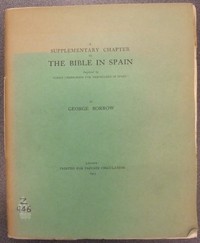
The source record for A Supplementary Chapter to the Bible in Spain — Key Ideas to Explore measures this digital text at 12,940 words, 57 min estimated reading time, and 2 detected text sections.
The text analysis averages about 29.6 words per sentence, while the detected sections provide another way to judge how the source is divided.
Project Gutenberg metadata also associates the work with “Spain -- Description and travel,” connecting these edition facts with the source record’s subject description.
Explore this collection
These alternatives are selected using recorded categories and estimated reading time.
About 58 minutes
Geography
13,227 recorded words. 1 minutes difference from this book's estimate.
View Gutenberg source #32539About 65 minutes
Geography
14,920 recorded words. 8 minutes difference from this book's estimate.
View Gutenberg source #35276About 67 minutes
Geography
15,408 recorded words. 10 minutes difference from this book's estimate.
View Gutenberg source #27366Search stored excerpts and compare books → Choose by your preferences →
Choices use stored catalog measurements. Estimates vary with reading speed. A shared category is a catalog label, not a claim that two books have the same argument or literary quality.
Search reads excerpt text stored with this catalog and links to its associated Gutenberg record. The connection is stored in the site database; this tool does not recheck that every excerpt is word-for-word identical to that external record. Excerpt search does not cover every chapter and does not verify historical publication dates.
Catalog snapshot checked: 2026-09-26. Coverage: 97 public books, 97 available source excerpts.
Calculated from edition completeness, EPUB availability, text structure and catalogue metadata. Not a user rating.
Total of 100 points, scaled to a 2.5-5.0 range. Editions with an empty description or a missing EPUB file are not scored.
Public-domain source text
The source text is kept in the dedicated reader, separate from this catalogue record and its commentary.
George Borrow's A Supplementary Chapter to the Bible in Spain originated as a commissioned review of Richard Ford's Hand-Book for Travellers in Spain for The Quarterly Review, but it never appeared in that form. Borrow withdrew the essay when editor John Gibson Lockhart proposed inserting extracts from Ford's work, unwilling to allow any tampering with his text. The result is a standalone piece that showcases Borrow's distinctive voice: a blend of sweeping geographical description, sharp cultural commentary, and personal enthusiasm for Spain's landscapes and people.
The prefatory note by editor Thomas J. Wise recounts the essay's unusual publication history. Lockhart, then editing The Quarterly Review, found Borrow's submission to be “hardly a word of ‘review’” and proposed to insert extracts from Ford's volumes himself—a common practice. Borrow's indignant response included a squib: “Would it not be more dignified / To run up debts on every side, / And then to pay your debts refuse, / Than write for rascally Reviews?” The essay was set in type but suppressed, surviving only in this privately printed 1913 edition. The episode illuminates Borrow's fierce independence as a writer and his refusal to have his work reshaped for a periodical's conventions.
Borrow's prose thrives on juxtaposition. He describes Spain as “hovering between Europe and Africa, between civilisation and barbarism,” a country where “antiquity treads on the heels of to-day” and “Paganism disputes the very altar with Christianity.” His catalogue of Spanish landscapes moves from “Elysian gardens of the vine, the olive, the orange, and the aloe” to “trackless, vast, silent, uncultivated wastes, the heritage of the wild bee.” This rhetorical structure—piling contrasting images in long, rhythmic sentences—creates a sense of abundance and complexity, inviting the reader to see Spain as a place of extremes rather than a single, uniform destination.
Borrow addresses a series of imagined visitors—the antiquarian, the man of feeling, the lover of art, the artist, the geologist, the botanist—each with a specific invitation. The antiquarian may “pore over the stirring memorials of many thousand years,” while the artist can “sketch the lowly mosque of the Moor, the lofty cathedral of the Christian.” The geologist is directed to “mountains of marble, and metal-pregnant sierras,” the botanist to “the wild hothouse of nature.” This structured list, punctuated by the Latin exclamation “sed ohe! jam satis,” demonstrates Borrow's method of organizing his material around the interests of different readers, a technique that mirrors the practical aims of a handbook while remaining distinctly personal.
Borrow's diction is deliberately elevated and sensory. He speaks of “the racy freshness of an original, unchanged country” and “the poetry of her envy-disarming decay.” His sentences often build through parallel clauses, as in the extended passage beginning “here let the antiquarian… here let the man of feeling… here let the lover of art…” This anaphoric structure gives the prose a rhythmic, almost incantatory quality, drawing the reader into a cumulative vision of Spain. Even when describing practical matters—rivers, roads, or inns—Borrow's language retains a vividness that distinguishes his travel writing from more pedestrian guides. The essay, though brief, exemplifies his ability to blend factual observation with personal enthusiasm.
Readers familiar with Borrow's The Bible in Spain will recognize the same energetic voice in this supplementary chapter, though the context is different: here he writes not as a missionary but as a critic and admirer of another's work. The essay stands as a record of a literary disagreement and a testament to Borrow's refusal to compromise his style. For those new to his writing, it offers a concentrated sample of his descriptive powers and his deep engagement with Spanish culture.
Reading Borrow’s unpublished quarrel with Ford, I recalled sitting under a juniper in New Mexico, tracing canyon shadows with a finger, feeling the land itself was a stubborn, unspoken argument. That same ache for a place needing no approval surfaced in Through Our Unknown Southwest The Wonderland of the United States—Little Known and Unappreciated—The Home of the Cliff Dweller and the Hopi, the Forest Ranger and — Context and Discussion. Both books whisper about loving what others simply pass by.
Answer a few questions and save a private reflection on this device.









