About 359 minutes
The Diary of an Ennuyée — Text and Context
Geography
82,367 recorded words. 1 minutes difference from this book's estimate.
View Gutenberg source #18049
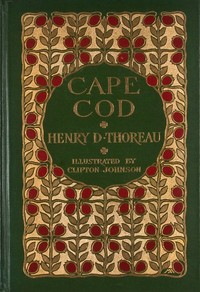
Before opening Cape Cod — Themes and Context, the edition data offers a quick orientation: 82,731 words, 6 hr estimated reading time, and 14 detected text sections.
The text analysis averages about 28.4 words per sentence, while the detected sections provide another way to judge how the source is divided.
Project Gutenberg metadata also associates the work with “Cape Cod (Mass.) -- Description and travel,” connecting these edition facts with the source record’s subject description.
Explore this collection
These alternatives are selected using recorded categories and estimated reading time.
About 359 minutes
Geography
82,367 recorded words. 1 minutes difference from this book's estimate.
View Gutenberg source #18049About 365 minutes
Geography
83,843 recorded words. 5 minutes difference from this book's estimate.
View Gutenberg source #31646About 350 minutes
Geography
80,283 recorded words. 10 minutes difference from this book's estimate.
View Gutenberg source #27881Search stored excerpts and compare books → Choose by your preferences →
Choices use stored catalog measurements. Estimates vary with reading speed. A shared category is a catalog label, not a claim that two books have the same argument or literary quality.
Search reads excerpt text stored with this catalog and links to its associated Gutenberg record. The connection is stored in the site database; this tool does not recheck that every excerpt is word-for-word identical to that external record. Excerpt search does not cover every chapter and does not verify historical publication dates.
Catalog snapshot checked: 2026-09-26. Coverage: 97 public books, 97 available source excerpts.
Calculated from edition completeness, EPUB availability, text structure and catalogue metadata. Not a user rating.
Total of 100 points, scaled to a 2.5-5.0 range. Editions with an empty description or a missing EPUB file are not scored.
Public-domain source text
The source text is kept in the dedicated reader, separate from this catalogue record and its commentary.
Thoreau opens Cape Cod with a shipwreck, immediately establishing a tone of stark realism. The narrative voice is characteristically direct, blending factual report with philosophical asides. Throughout the excerpts, Thoreau's diction oscillates between the colloquial—'a landsman'—and the scientific, as when he notes the Latin name Globicephalus Melas for the blackfish. His descriptions are tactile: blubber 'about three inches' thick, flesh 'firm and red like beef.' This attention to sensory detail grounds his observations in the physical world.
Thoreau's word choices reveal a narrator who is both participant and detached analyst. When describing the blackfish drive, he notes the 'simple stiff-looking flippers' and the 'blunt round snout'—terms that are precise yet unadorned. He reports the fisherman's casual remark about preferring blackfish flesh to beef, letting the local voice speak without editorializing. This technique creates a layered text: the reader receives raw data alongside the author's quiet judgments. The phrase 'I witnessed such a scene in July, 1855' anchors the account in personal experience, yet Thoreau never becomes the story's hero. He remains an observer, one who counts 'about thirty blackfish, just killed, with many lance wounds' and notes the 'bloody' water. His stance is that of a naturalist, but his prose carries a wry undercurrent, as when he remarks on the delay before a boat can depart: 'It is something new to a landsman, and at first he is not disposed to wait.'
Thoreau incorporates snippets of local speech to animate his narrative. The carpenter who 'did not know but he had lost fifty dollars by coming to his work' because he missed the blackfish drive speaks in a vernacular that reveals economic priorities. The fisherman who 'slashed one with his jackknife, to show me how thick the blubber was' demonstrates a practical intimacy with the catch. These voices are not romanticized; they are reported with the same fidelity Thoreau gives to the landscape. The exchange about waiting for the tide—'Well! you can't start for two hours yet'—captures the Cape's unhurried rhythm. By letting residents speak in their own idiom, Thoreau avoids the trap of the condescending outsider. His own responses are minimal, often limited to a single phrase like 'I had expected' or 'I could see,' which keeps the focus on the inhabitants and their environment.
Thoreau's descriptions of the Cape's geography and wildlife are meticulously detailed. He notes the 'pond three eighths of a mile long densely filled with cat-tail flags, seven feet high' and the 'slender grass-like seaweed (Zostera)' absent from the Atlantic side. These observations serve a dual purpose: they document the region's ecology and reflect Thoreau's methodical mind. The blackfish passage is a tour de force of descriptive writing. He measures the largest at 'about fifteen feet long,' notes the blubber thickness 'about three inches,' and even tests it with his finger, finding it 'covered thick with oil.' The comparison of blubber to pork and flesh to beef is deliberately homely, grounding the exotic in the familiar. Thoreau's eye for incongruity—the 'smooth shining black, like India-rubber' bodies of the whales—adds a layer of strangeness. He never anthropomorphizes; the animals remain 'simple and lumpish forms,' their reality unsoftened.
The book's chapter titles—'The Shipwreck,' 'Stage-coach Views,' 'The Beach,' 'The Wellfleet Oysterman'—suggest a linear journey, but Thoreau's narrative often loops back to the shore. The excerpts show a pattern of movement: walking along the beach, encountering a scene, then pausing for extended description. This rhythm mimics the tidal ebb and flow. Thoreau uses the journey as a frame for digressions, such as the historical note about 'two inhabitants of Truro' who first voyaged to the Falkland Isles in 1774. These asides broaden the scope without breaking the narrative's momentum. The prose moves from the general ('A frequent answer is, Well! you can't start for two hours yet') to the specific (the blackfish's 'lance wounds'), then back to reflection. This structure allows Thoreau to weave natural history, local anecdote, and personal observation into a cohesive whole, held together by his distinctive, unhurried voice.
Readers attentive to Thoreau's prose will notice how he uses small details—the thickness of blubber, the color of seaweed, a fisherman's offhand comment—to build a portrait of Cape Cod that is both intimate and unsentimental. His authorial choices in diction and dialogue reward careful reading; the book's value lies not in grand conclusions but in the precision of its observations. Approach Cape Cod as a series of field notes from a keen-eyed traveler, and let Thoreau's voice guide you through the sand and surf.
Rain drummed on the windows that afternoon, and Thoreau’s blunt talk of shipwrecks and salvage kept me company. There’s a particular way he notes the sea’s indifference, which made me think of other shores. Some weeks later, I found myself turning pages about Romanian plains, a different coast entirely, in Roumania Past and Present — A Reader’s Guide. The connection was quiet, accidental, but real.
Build a private reading journal entry for this title.









